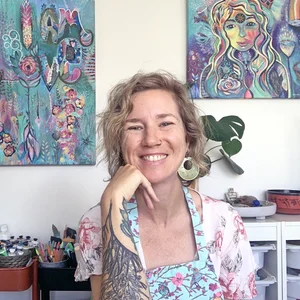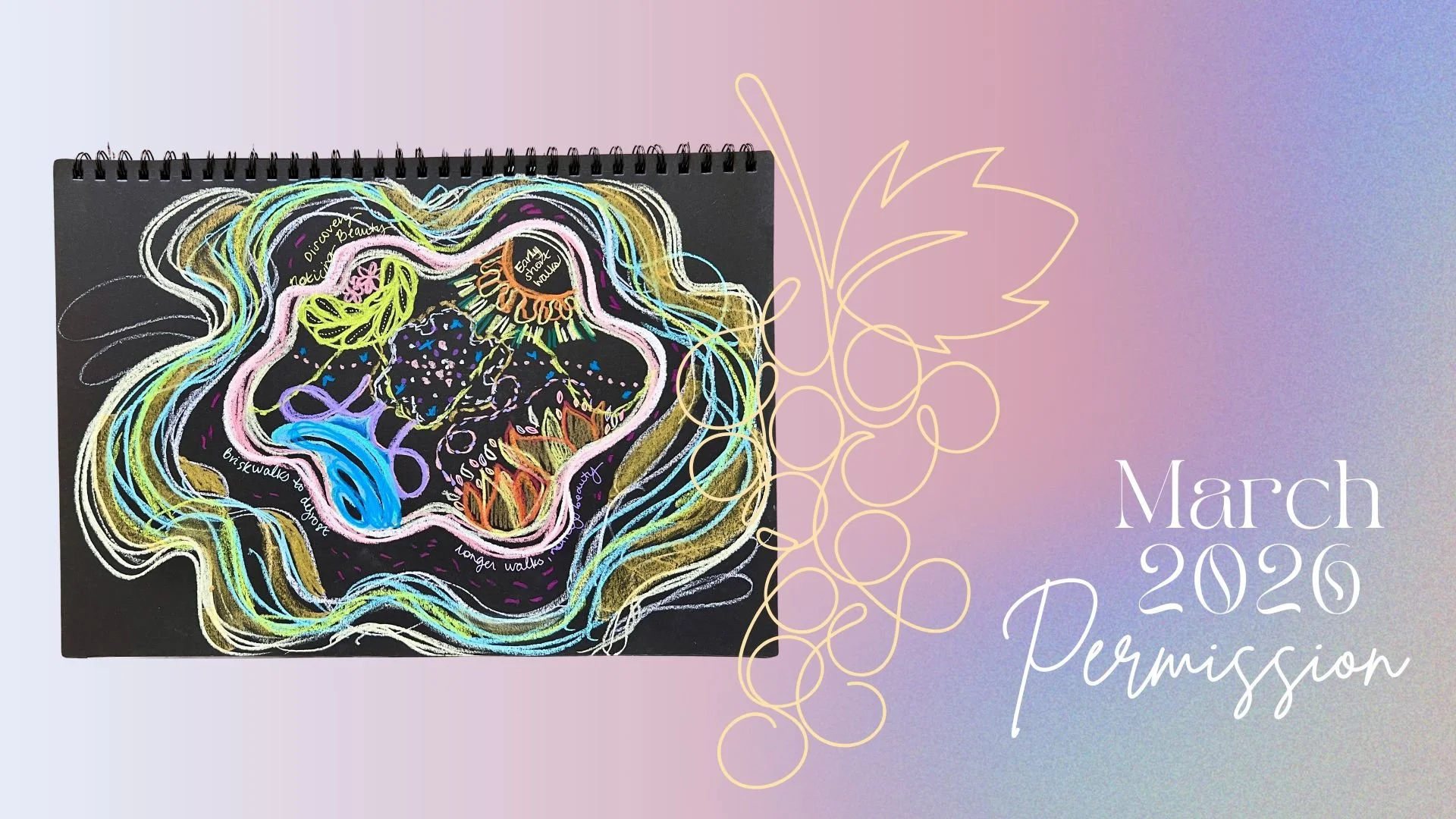
Carving out time for creativity can often feel loaded with shoulds, expectations and fears - before we even get started. Granting ourselves Permission is rarely an easy act, especially to begin with, and it takes understanding our barriers, as well as self-compassion, to create with more freedom and accessibility.
In this post, I’d like to share some barriers and flow-tips for bringing more creative ritual into our lives in adulthood and mid-life, and how it benefits our wellbeing when we do.
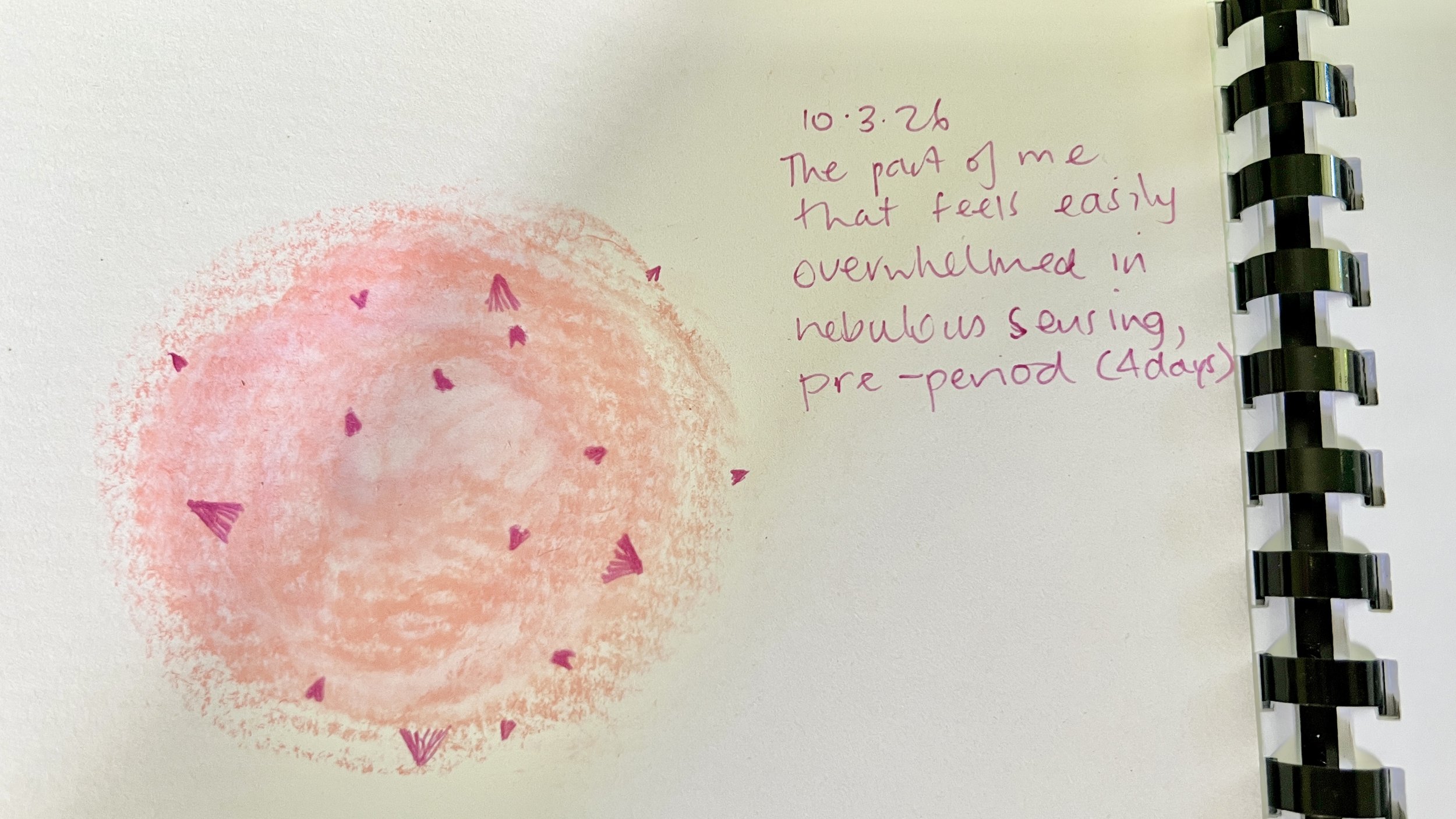
My Permission Story
As a late diagnosed Autistic-ADHD’er, I had spent much of my life following social rules and expectations, in order to feel like an accepted, legitimate human - even if it hurt me.
Even as someone who created fairly regularly, I would often prioritise meeting others’ expectations of me first, before finding the time to make art for me. I needed a ‘legitimate’ reason, and often, others’ reasons felt more important.
When I hit my 30’s, got married, and entered Motherhood, Permission took on a whole other level of intensity …
Beyond the ‘good girl’ rules I’d taken on from society growing up, I had also inherited a bunch of new rules about what it meant to be a ‘good mum’ and a ‘good wife’, most of which were outwardly focussed. All the outer responsibilities and expectations, physically, cognitively and emotionally, led me to some pretty intense overwhelm and barely knowing who I was anymore.
Now, as a perimenopausal, neurodivergent, solo Mum and art therapist, in my latter 40’s, Permission to identify and meet my own needs is no longer something I can mask past, nor do I want to.
I’m experiencing the gift of aging wisdom, and a distilling of passion-meets-capacity.
How to Overcome Barriers to Creativity
Before we discover what helps us carve out time for our creativity, I’ll share some of the common barriers I’ve come across in my decades of working with people in creativity, education and therapeutic arts, and how we can turn these perspectives and limitations around to support us.
You might like to consider these prompts to sense into which might feel true for you:
I’m a perfectionist - It can feel painful to participate in creativity when the outward creation doesn’t match the internal standards we’ve learnt to take on as our own, from others. Needing for our creations to be perfect doesn’t take into account the natural cycles of playful generation, exploration and non-linear processing that creativity often entails, and this can feel painful for some of us, to step into the unknown. Sometimes, we need to pare things riiiight back and set an intention for small achievements. What if, I simply learned to play with watercolours on a scrap of paper, and watched the colours merge? What if I used existing objects such as magazine images or LEGO, and explored creating with these, to overcome representational fears? What if I explored repetitive movements such as rolling clay in my hands, or drawing dots on a page to connect them? It can often be our learnt expectations that supercharge perfectionism, so if we can shift our expectations into achievable explorations, this can really help.
Creative supplies are not accessible - If we don’t have any arts & crafts supplies on hand, don’t have a space to use them at home, can’t afford them, or we have a physical disability impacting our ability to hold and manipulate materials, these barriers can impact to getting started in the first place. Over the years, I have worked with able-bodied people as well as people with limited physical capacity. We’ve doodled with simple ball-point pens, and expensive supplies. We’ve created in a notebook and large scale murals spanning hundreds of square metres. In all of these circumstances, we’ve found a way by adapting expectations, and working within what’s achievable. There are always ways to create, even with free supplies and with different parts of our bodies, with support of others alongside us (body-doubling, youtube tutorials etc), that can help make accessing creativity more easeful.
Believing ‘I’m not good enough’ - This is the one I see the most in society and people I’ve had the pleasure to create alongside. If I had a dollar every time I heard someone say “I can’t even draw a stick figure!” - honestly, that sounds like a very boring choice to use a stick figure as a measure of art-making, so let’s expand our perspectives 💗 Just as we don’t need to be an olympian to go for a swim, we don’t need to identify as an artist to enjoy being creative. Nor to we need to be a chef to cook, or a dancer to move our bodies to music. Often, somewhere along the line we can track back to a teacher or other person commenting negatively about our artistic expressions, which we then internalised as truth. Your ability to draw realistically does not equate to your capacity or worthiness to create. Ever. Similarly, a pleasing end product isn’t the only outcome of creating - the joy in making, feeling the art supplies moving in your hands, watching the colours and shapes emerge, exploring, playing … these processes are just as, if not more important than the outcome. What if play and exploration became the intention? How could this shift our approach to permitting ourselves to engage in creativity?
Low energy - Low energy can feel like a legitimate reason to not give ourselves permission to create - especially in perimenopause /menopause / mid-life, when we often have many responsibilities, alongside lowered capacity. If we feel we only have one-bar-left of internal battery, it may seem too hard to get out the easel and whip up a painting. Here is where scale and accessibility come into play. Experiencing the benefits of engaging in creativity does not need to come from grandeur activities. Enjoying a colouring-in book over Netflix, knitting over a cuppa with a friend, cutting out some beautiful images from your fave magazine, even doodling in the margins of your journal can all be simple, achievable, low energy experiences that also bolster our creative expression and wellbeing.
External responsibilities - Ugh - this can often feel like the biggest barrier as an adult to carving out time for creative experiences. Most of us feel spread thin between our family, work and life responsibilities, often leaving only a tiny sliver of the pie for ourselves. However, we often find time to scroll our phones as an effort to recoup our sense of agency and mojo. What if instead, we left a notebook and coloured pens beside the bed, or lounge, and reached for those instead? If we are waiting for spare time to carve out permission to nourish our creative needs, we will quite simply, wait forever. We can. however, start small, and find ways to habit stack, to begin making creativity a nourishing ritual in our weekly experience. Take note of the time you have and the physical spaces you might reach for your phone, and instead, plant some creative offerings there. It could be as simple as an inspiring craft book in the toilet, or a pen and pencil beside the bed. Use the little pockets of time for creative permission, instead of the pressure of long/large projects, and allow the momentum to build.
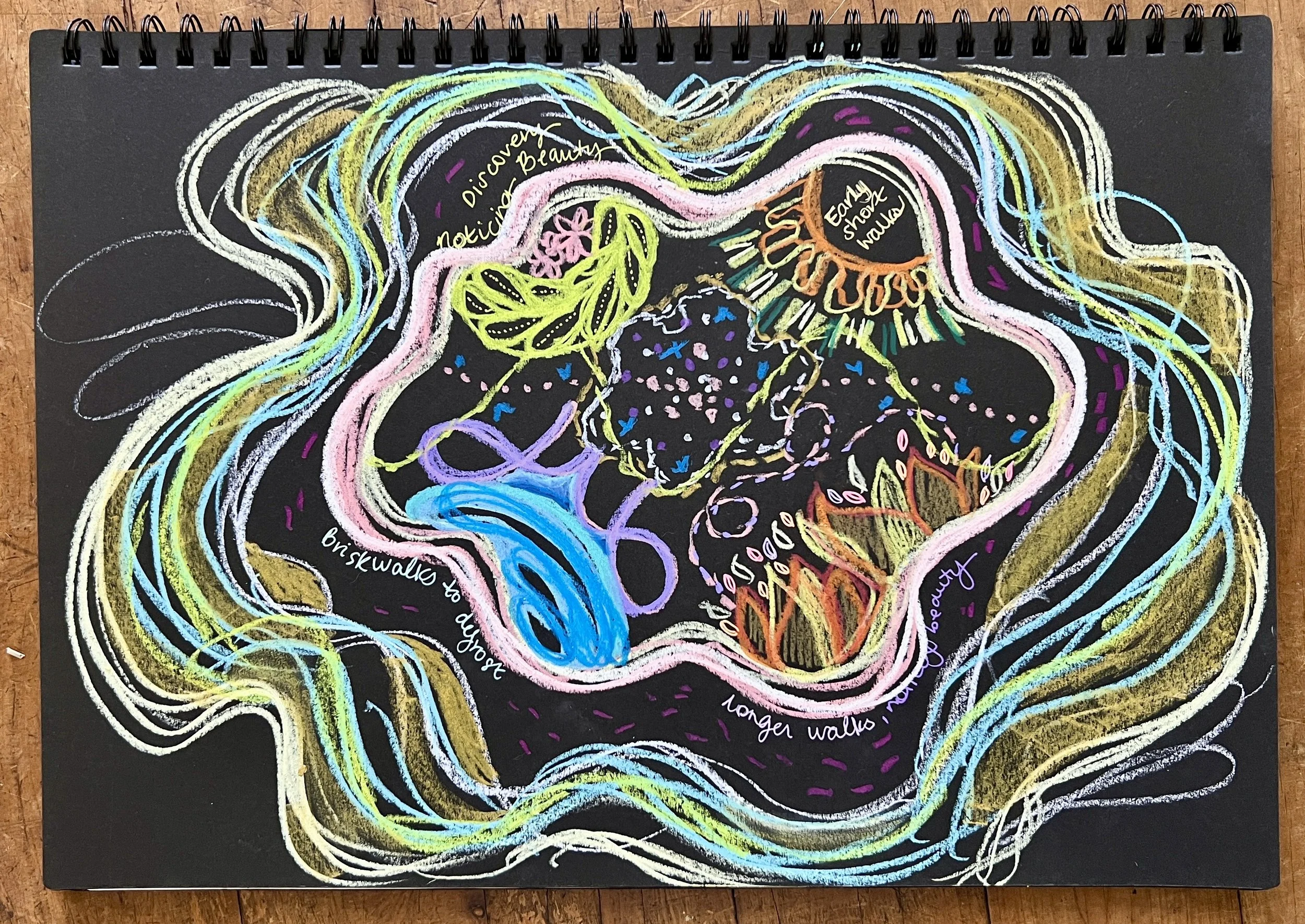
More Tips for Permission, in mid-Life
For me now, Permission often means putting my needs first, before stretching outwards. That’s been a hard one to learn, and I’m still a work in progress. Before creativity, sometimes we need to bolster our capacity for life. These may include:
Asking for help (even if it shows others I’m not capable right now)
Noticing my own natural rhythms (even if that differs to clock time and calendars)
Rescheduling catch ups when I feel overwhelmed (even if others might judge or mock me for it)
Prioritising a daily, morning movement ritual (even when there are 100 other tasks on my to-do-list)
Relaxing on the lounge with my sketchbook, hot pink paint and buttery crayons (even when there are piles of dishes in the sink)
I hope this post has brought some inspiring and meaningful strategies to choose from. I invite you to explore one that feels achievable for you this week, and notice how you feel afterwards.
In my experience and everyone I’ve co-created alongside, its’ always time well spent, and afterwards, brings a sense of relaxation, upliftment and self-nourishment.
Your Creative Invitation 🌸
If you’re in mid-life and you’d like support to carve out some regular and nourishing creativity, I invite you to join my Peri-Women-Pause therapeutic arts workshops, designed to nourish your spirit and support your unique peri-path.
Join us every months or on a casual basis to experience gentle education, creative expression and community connection: a sanctuary for you to explore nourishing creativity, and restore your mojo.
I hope to see you there.
With care and creativity.
Chrissy

Reclaim Your Rhythm in Perimenopause via Monthly, Guided, Creative Self-Care
For Women in Perimenopause 35+
Join us LIVE 3rd Wednesday of each month
6:30-8pm Brisbane time (AEST)
Online, via zoom
BYO art supplies (see list below)
🌸 This listing is for Peri-Women-Pause Guided Online Workshop - Casual bookings $59 (Use the ‘Book Me In’ button within this listing)
OR
✨ Join our Peri-Women-Pause Monthly Membership for $45 and get $14 off your monthly workshop fee + gain access to our PWP Member’s Studio (includes your zoom link, session dates, materials list, copy of session slides, freebies + more) — CLICK HERE
Embrace change via supportive, creative togetherness
Welcome to Peri-Women-Pause (PWP): Your restorative, monthly, online therapeutic arts experience, designed to nourish your mojo, spirit and support your unique peri-path.
Each guided session blends gentle education, creative expression and community connection: A sanctuary for you to explore nourishing creativity, restore your mojo, and experience belonging on your transformative peri-journey🐦🔥💫🎨
You bring along some arts or crafts supplies, and I’ll provide the online guided creativity and nourishing education for your perimenopausal self-care.
No experience necessary, just a willingness to care out time for personal regeneration, and connecting with your creative side.
Grab a cup of your favourite tea, some arts supplies, and let’s creatively reconnect.
Here’s how it works:
👉 On the Third Wednesday night of each month, we gather online for Peri-Women-Pause. 6:30-8pm Brisbane time (AEST) 🌸🐦🔥
👉 Here’ you’ll experience 1.5 nourishing hours of guided creativity each month, dedicated to nourishing self-care and education for transforming peri-women, in togetherness.
👉 Each month will explore a different theme, such as PERMISSION, REST and RECLAIM, guided with care and understanding by Chrissy (also in peri!), using simple art and craft supplies, and bite-sized morsels of therapeutic, peri-inspired research.
👉 We wrap up each session with reflections on what worked well for us, and how to bring nourishment into our everyday lives 🌸
It’s a gift you can give yourself every month. A time to slow down, rejuvenate your mind and nervous system, and honour your self-care boundaries.
From one peri-woman to another - Let’s create a revolution of prioritising our needs for ongoing, meaningful restoration. I hope you will join us 🫶🏽
Upcoming 2026 dates & themes:
Held LIVE on 3rd Wednesday night of each month, 6:30 - 8pm Brisbane time (AEST)
· Feb 18th (Theme: Rest)
· Mar 18th (Theme: Permission)
· Apr 15th (Theme: Needs)
· May 20th (Theme: Deepening)
· June 17th (Theme: Release/Shed)
· July 15th (Theme: Beautify)
· Aug 19th (Theme: Soften)
· Sept 16h (Theme: Reimagine)
· Oct 21st (Theme: Lighten)
· Nov 18th (Theme: Reclaim)
· Dec 9th (Theme: Strong Base) – Note this monthly session is 1 week earlier.
Who it’s for:
Peri-Women-Pause is a safe and welcoming space for anyone experiencing perimenopause, including people with ovaries, or identify as a woman, trans. queer, non-binary or intersex folk.
Each session will include neuro-affirming prompts to foster inclusive access.
This is an intentionally safe, affirming and non-judgemental space, where our community can feel secure and each benefit from shared perspectives. Inclusivity and safety is paramount here 🌈🌻
How to book:
Casual Bookings: $59 Book your preferred workshop via the ‘Book Me In’ button within this listing, then click on the CART ICON to payment. (You'll receive the zoom link via email after booking)
Monthly Membership: $45 Save $14 every session and access the PWP online studio BECOME A MEMBER HERE.
Example BYO art materials:
Each month, bring along materials that feel most exciting or nourishing for you on the day. The guided creative sessions enable you to work with a variety of materials, using the prompts provided.
You may choose any of the following:
A surface: printer paper, visual journal, cardboard, notebook, recycled cardstock
Drawing: e.g. coloured pencils, pens, markers, paint pens, gel pens
Painting: e.g. watercolours, little tubes of paint & brushes
Collage: magazines, old cards, wrapping paper, scissors, glue stick, tape, blu-tak
Sculpture - clay, LEGO, blocks, natural items (e.g. seed pod, flowers, trinkets, shells, jewellery, crystals)
Craft - sewing, crochet, knitting, tapestry
Self-care items - drinks, snacks, fidgets or accommodations for comfort and participation
Important Information:
Peri-Women-Pause (PWP) offers a relaxed and nourishing environment designed to help you carve out time for meaningful, creative self-care. As a participant, it is essential to prioritise your self-awareness and self-care needs during each workshop, and engage only in ways that feel genuinely nourishing for your system (i.e. not overriding your capacity).
PWP is not a substitute for individualised medical, or professional mental/emotional health support, therapy, or personal guidance.
I am unable to provide individual support during PWP experiences, or afterwards via email. If you experience any acute physical, mental or emotional challenges, please seek help from a trusted professional for one-on-one support.
Thank you for taking care of your needs and helping to ensure our group is a safe space for all participants to experience 💖
Love Chrissy x